Cyanobacteria Harmful Algal Bloom Advisories

Harmful algal blooms (HABs) can cause serious illness or death in pets and livestock that ingest water or mats containing high concentrations of cyanotoxins. Dogs can become extremely ill, and even die, within minutes to hours of exposure to cyanotoxins from drinking water, licking their wet fur or eating floating mats or dried crust along the shore.
What to Watch For
A harmful algal bloom can look foamy, scummy, thick like paint, and pea-green or blue-green in color. It can look like a thick green or brownish-red mat, or bright green clumps suspended in the water. If you find thick, brightly colored foam, scum or mats in a lake, pond, river or stream—especially in shallow, marshy areas where cyanobacteria blooms can form—don’t let your pet drink or swim in the water.
Benthic algal mats have been identified in the Columbia River, which led to the deaths of two dogs in 2024. Cyanobacteria that predominantly grow on the bottom (benthos) of waterbodies are referred to as “benthic cyanobacteria.” The color of the material is diverse, ranging from vibrant yellow-green and drab olive, to burgundy and dusky brown or black and may be in the form of algal mats. The risk of exposure to benthic blooms increases significantly when the cyanobacteria mats dislodge from the bottom, become buoyant, and accumulate along shorelines, backwater channels, or eddies via wind or water current.
More Resources
- This US Forest Service resource can help you tell the difference between normal algae and toxic algae.
- The HAB photo guide from the California Water Quality Monitoring Council offers several photos of algal blooms. Pages 12-24 cover planktonic blooms (the kind usually seen in Oregon), and pages 25-36 focus on benthic mats (the kind seen on the Columbia).
Advisories Issued by Oregon Health Authority
Reminder: Not all Oregon waterways are monitored for cyanotoxins. A water body with no recreational health advisory does not mean that a bloom is not present.
Advisories or precautions do not mean a body of water or an area is "closed." You can still enjoy the areas listed below while exercising caution with water exposure. OHA shares advisories to help people (especially those with young children) and pet owners to be aware of the potential exposure to their pets while at these areas. Toxins cannot be removed by boiling, filtering or treating water with camping-style filters. Remember—when in doubt, stay out!
Types of Advisories
- Advisory: Cyanotoxin levels have been confirmed through testing to be unsafe for swimming and boating at speeds that cause water to spray into your face, OR a combination of conditions indicate that cyanotoxin levels may be unsafe for these activities. Toxin levels are unsafe for pets.
- Precaution: A bloom has been confirmed or cyanotoxins are present but at levels that are safe for human recreation. Toxin levels may still be unsafe for pets.
- Advisory downgraded to precaution: An 'advisory' is downgraded to a 'precaution' when water testing shows safe levels for human recreation, but a bloom or toxins are still present. Toxin levels may still be unsafe for pets.
- Lifted: Testing shows cyanotoxins are not present, or when the bloom is visibly gone.
| Waterbody | Icon | Status | Date | County | Toxin/Measure | Details |
|---|---|---|---|---|---|---|
 | Precaution in effect | 11/3/2026 | Baker | Microcystin 6.64 ug/L | Visible bloom | |
North Tenmile Lake | | Precaution in effect | 10/30/2026 | Coos | ||
| Precaution in effect | 10/29/2026 | Lincoln | | Visible bloom | |
| Precaution in effect | 10/21/2026 | Clatsop |
| ||
Howard Prairie Lake | | Precaution in effect | 10/13/2026 | Jackson | Microcystin 0.18 ug/L | Visible bloom |
Lake Billy Chinook |  | Precaution has been lifted | 10/12/2026 | Jefferson | | |
Lake Wallula / Columbia River (from McNary Dam to Washington border) | | Precaution has been lifted | 10/12/2026 | Umatilla | | |
Lake Selmac | | Precaution in effect | 10/7/2026 | Josephine | Microcystin 1.06 ug/L | |
Willamette River - Portland (South of Ross Island Lagoon to Kelley Point Park and St. Helens | | Precaution has been lifted | 10/7/2026 | Columbia | Microcystin 1.04 ug/L | |
Willamette River - Portland (South of Ross Island Lagoon to Kelley Point Park and St. Helens | | Precaution has been lifted | 10/7/2026 | Multnomah | Microcystin 1.04 ug/L | |
Penland Lake | | Precaution in effect | 10/6/2026 | Morrow | Microcystin 0.13 ug/L | Visible bloom |
Daly Lake | | Precaution has been lifted | 10/2/2026 | Linn | ||
Haystack Reservoir | | Precaution has been lifted | 10/2/2026 | Jefferson | ||
Fern Ridge Reservoir | | Precaution has been lifted | 9/28/2026 | Lane | ||
Paulina Lake | | Precaution has been lifted | 9/25/2026 | Deschutes | | |
| Precaution has been lifted | 9/22/2026 | Klamath | | ||
Owyhee Reservoir | | Precaution in effect | 9/21/2026 | Malheur | Saxitoxin 0.27 ug/L | Visible bloom |
Blue Lake | | Precaution in effect | 9/17/2026 | Multnomah | Visible bloom | |
| Advisory has been lifted | 9/11/2026 | Baker | | ||
| Advisory has been lifted | 9/11/2026 | Union |
| ||
| Precaution in effect | 9/10/2026 | Klamath |
Microcystin 6.58 ug/L | Visible bloom | |
Yamhill River (from Lafayette Locks Historical Park to confluence with Willamette | | Precaution has been lifted | 9/2/2026 | Yamhill | ||
Agate Reservoir | | Precaution in effect | 8/21/2026 | Jackson | Microcystin 2.46 ug/L | Visible bloom |
Diamond Lake | | Precaution in effect | 8/21/2026 | Douglas | Visible bloom | |
Lemolo Lake | | Precaution in effect | 8/21/2026 | Douglas | Visible bloom | |
Oswego Lake | | Precaution in effect | 8/19/2026 | Clackamas | Microcystin 0.48 ug/L | |
Phillips Lake | | Precaution in effect | 8/19/2026 | Baker | Visible bloom | |
Unity Reservoir | | Precaution in effect | 8/19/2026 | Baker | Microcystin 0.78 ug/L | Visible bloom |
Devils Lake | | Precaution in effect | 8/6/2026 | Lincoln | | Visible bloom |
| Precaution in effect | 7/27/2026 | Crook | Microcystin 2.15 µg/L | Visible bloom | |
Clackamas Cove | | Precaution in effect | 7/23/2026 | Clackamas | Anatoxin-A 0.36 ug/L Microcystin 0.13 ug/L Saxitoxin 0.32 ug/L | Visible bloom |
Timothy Lake | | Precaution has been lifted | 7/21/2026 | Clackamas | ||
 | Advisory in effect | 7/20/2026 | Baker | Microcystin > 10 ug/L | Visible bloom | |
Dexter Reservoir | | Precaution in effect | 7/20/2026 | Lane | Visible bloom | |
| Advisory in effect | 7/20/2026 | Baker | Microcystin > 10 ug/L | Visible bloom | |
| Advisory in effect | 7/20/2026 | Wallowa | Microcystin > 10 ug/L | Visible bloom | |
Wapato Marsh at Oaks Bottom | | Precaution in effect | 7/14/2026 | Multnomah | Microcystin 0.26 ug/L | |
| Advisory in effect | 7/10/2026 | Marion | Microcystin 7.06 ug/L | Visible bloom | |
Siltcoos Lake | | Precaution in effect | 7/8/2026 | Douglas | Microcystin 0.27 ug/L | |
Siltcoos Lake | | Precaution in effect | 7/8/2026 | Lane |
Microcystin 0.27 ug/L | |
North Fork Santiam River | | Precaution in effect | 7/2/2026 | Marion |
Microcystin 0.3 ug/L | |
Ochoco Reservoir | | Precaution in effect | 6/18/2026 | Crook |
Microcystin 2.13 ug/L | |
Suttle Lake | | Precaution in effect | 6/18/2026 | Jefferson | | Visible bloom |
Detroit Reservoir | | Precaution in effect | 6/12/2026 | Linn | Microcystin 0.18 ug/L Cylindrospermopsin 0.10 ug/L | |
Detroit Reservoir | | Precaution in effect | 6/12/2026 | Marion | Microcystin 0.28 ug/L | |
Gerber Reservoir | | Precaution in effect | 6/12/2026 | Klamath | Visible bloom | |
South Tenmile Lake | | Precaution in effect | 6/5/2026 | Coos |
Microcytin 2.13 ug/L | |
Hyatt Lake | | Precaution in effect | 6/3/2026 | Jackson |
Anatoxin-a 0.54 ug/L | Visible bloom |
Lost Creek Lake | | Precaution has been lifted | 5/29/2026 | Jackson | Non-detect | |
Sturgeon Lake | | Precaution in effect | 5/29/2026 | Columbia | | Visible bloom |
Sturgeon Lake | | Precaution in effect | 5/29/2026 | Multnomah | | Visible bloom |
| Advisory in effect | 5/28/2026 | Klamath |
Microcystin 8.27 ug/L Cylindrospermopsin 0.06 ug/L Anatoxin-a 0.16 ug/L
| ||
Upper Klamath Lake | | Precaution in effect | 5/21/2026 | Klamath | Microcystin 0.77 ug/L | Visible bloom |
Cold Springs Reservoir | | Precaution in effect | 5/20/2026 | Umatilla |
Microcystin 1.95 ug/L | |
McKay Reservoir | | Precaution in effect | 5/15/2026 | Umatilla | Non-detect | Visible bloom |
Willow Creek Reservoir | | Precaution in effect | 5/15/2026 | Morrow | Microcystin 0.13 ug/L | Visible bloom |
| Permanent Advisory | Douglas | Posted Sign |
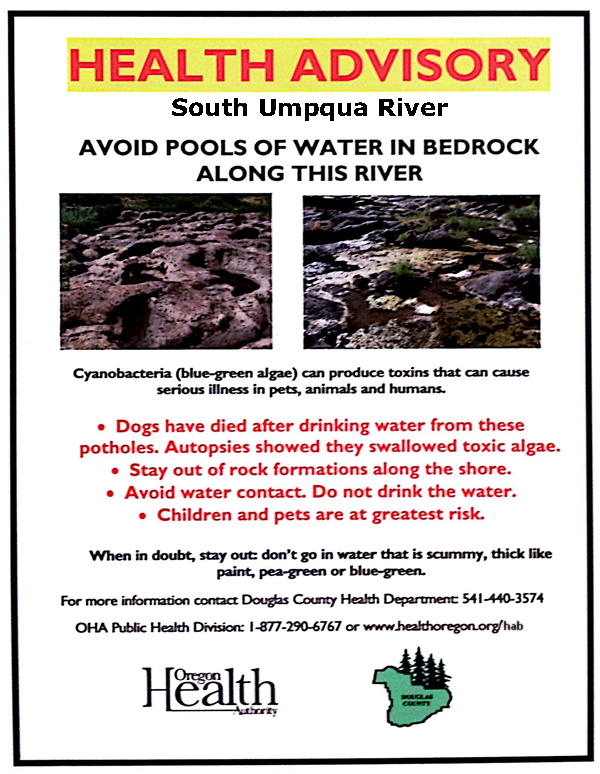
Table: Oregon Health Authority
Maps
Oregon Harmful Algal Bloom Advisory Map
McKenzie Watershed Harmful Algal Bloom Monitoring Map
Advisories in Surrounding States
Children and Pets are Particularly Susceptible
The most common toxins in harmful algal blooms in Oregon are microcystins and cylindrospermopsin. Exposure to these toxins can produce symptoms of numbness, tingling and dizziness that can lead to difficulty breathing or heart problems and require immediate medical attention. Symptoms of skin irritation, weakness, diarrhea, nausea, cramps and fainting should also receive medical attention if they persist or worsen. Children and pets are particularly susceptible.
Swallowing or inhaling water droplets should be avoided, as well as skin contact with water by humans or animals. Drinking water from affected bodies of water is especially dangerous. Toxins cannot be removed by boiling, filtering or treating the water with camping-style filters.
Oregon Public Health recommends that people who choose to eat fish from waters where algae blooms are present should remove all fat, skin and organs before cooking since toxins are more likely to collect in these tissues.
Symptoms in Dogs
Exposure to a harmful algae bloom can result in:
- Weakness or collapse
- Nausea, vomiting
- Excessive drooling
- Weakness, fatigue, stumbling
- Abdominal pain
- Diarrhea
- Difficulty breathing
- Shaking, trembling
- Seizure like activity—tremors, rigidity, paralysis
- Liver failure
If your dog goes into the water:
- Don’t let your pet lick its fur.
- Wash your pet with clean water as soon as possible.
- If your dog has symptoms such as drooling, weakness, vomiting, staggering and convulsions after being in water, seek immediate veterinary care. Acute, life-threatening symptoms from cyanobacteria toxins often develop rapidly. Death can occur within minutes to hours after exposure.
Updated / Reviewed: November 4, 2026